Casino software directly affects your gaming experience. It determines how smooth, secure, and enjoyable your time on a platform will be. Here's what you need to know:
- Graphics: Poor software can lead to blurry visuals, text alignment issues, and inconsistent quality across devices. Modern platforms use HD and 3D graphics to deliver sharp, vibrant visuals on both desktop and mobile.
- Performance: Slow load times, lag, and crashes are common with outdated systems. Advanced software reduces latency with tools like Content Delivery Networks (CDNs) and mobile-first designs for faster, smoother gameplay.
- Fair Play: Certified Random Number Generators (RNGs) ensure game outcomes are random. Reliable platforms also display clear Return to Player (RTP) rates, usually between 95–97%, giving players confidence in the system.
- Security: Platforms with strong software protect player data using encryption, multi-factor authentication, and compliance with standards like GDPR and PCI DSS. They also reduce downtime with redundancy and proactive maintenance.
Key takeaway: High-quality casino software ensures better graphics, faster performance, fair game outcomes, and strong security, making your gaming experience more enjoyable and trustworthy.
Graphics and Visual Quality
Problems Caused by Poor Graphics
When software falls short on graphics, it creates visual problems that can drive players away. One common issue is text truncation, where menus, buttons, or other interface elements appear misaligned or incomplete. This not only frustrates users but can also make the platform seem unreliable or untrustworthy. Such glitches often lead to dissatisfaction and negative reviews, which can harm a platform's reputation.
Another major drawback of outdated software is its reliance on low-resolution pixel art, which looks grainy and outdated on modern high-definition screens. When graphics appear sharp on desktop but blurry on mobile, it disrupts the gaming experience and creates inconsistency. Beyond just aesthetics, these issues can erode trust and discourage players from returning, ultimately undermining the platform’s broader goals of delivering fairness, high performance, and security.
How Modern Software Improves Visual Quality
Modern gaming software has transformed visual quality, offering HD graphics with crisp lines, vibrant colours, and detailed designs. Providers like NetEnt stand out with their HD instant-play technology, while BetSoft has gained recognition for its "Slots3" collection, which features stunning 3D animations.
The use of 3D graphics engines has further elevated the gaming experience. These engines allow developers to create realistic environments with three-dimensional models, detailed textures, and advanced lighting. As WGAMES explains:
The gaming experience gained depth, authenticity and a sense of realism thanks to the use of three-dimensional models, textures and lighting effects
. Evolution Gaming takes this a step further with live dealer games, streaming HD video from cutting-edge studios. This approach provides a level of realism that surpasses traditional computerised graphics.
Another key advancement is cross-platform optimisation, ensuring graphics look sharp whether players are on desktop or mobile. Modern software adapts high-resolution visuals for smaller screens while maintaining responsive touchscreen controls. For instance, NextGen Gaming, supplying over 600 premium games to more than 170 casino operators worldwide, uses HTML5 technology to deliver seamless instant-play experiences without compromising visual quality.
High-quality graphics are just one aspect of exceptional software design. When paired with fairness protocols, performance improvements, and robust security measures, they contribute to a gaming experience that players can trust and enjoy. Moreover, these advancements not only enhance visuals but also ensure smooth gameplay and reliable performance.
sbb-itb-b6f7e81
Gameplay and Performance
Issues with Slow and Unresponsive Gameplay
Latency - essentially the delay between a player's action and the game's response - can make or break the gaming experience. Poor-quality software can lead to noticeable lag, which is especially frustrating on mobile devices where quick reactions are crucial. Imagine placing a bet or spinning a reel, only to wait several seconds for it to register. It’s enough to drive players away. In fact, research shows that one in four visitors will leave a website if it takes more than four seconds to load, and 70% of users say page speed directly affects their willingness to spend money on a platform. Online gambling journalist Alex Hussain puts it plainly:
"In this fast-paced world, casinos that lag behind in load speed risk losing out on players, no matter how great their games or promotions are."
Mobile users face even more hurdles when software isn’t tailored for smartphones or tablets. Issues like clunky interfaces, unresponsive touch controls, and sluggish loading times create a frustrating experience. On top of that, delays in processing transactions can make players feel uneasy about the security of their funds, further eroding trust. During peak hours, poorly optimised hosting systems may buckle under the pressure, leading to even slower performance or outright crashes. Clearly, these problems call for smarter technical solutions to ensure smooth and responsive gameplay.
Performance Solutions Through Better Software
Modern casino platforms are tackling these challenges head-on with advanced software solutions. One key tool is the use of Content Delivery Networks (CDNs), which distribute data across multiple servers. By pulling information from the closest server, CDNs significantly reduce latency for players. Another effective strategy is lazy loading, which prioritises loading essential game elements first. This allows players to dive into the action immediately while larger media files load in the background. Today, top-performing casinos manage to load their initial content in under two seconds.
A mobile-first approach is also transforming the gaming experience. By designing streamlined code optimised for smartphones and then scaling up to desktops, developers ensure smooth gameplay across all devices. Additionally, cloud-based hosting systems offer automatic scaling, which means they can handle sudden surges in traffic - like during peak gaming hours - without slowing down or crashing. As Alex Hussain points out:
"A site's ability to handle a sudden influx of players without slowdowns is key to providing a good experience for players."
Integrated payment gateways further enhance performance by reducing transaction times, ensuring a seamless flow from logging in to cashing out. These advancements not only improve the overall gaming experience but also help build trust and loyalty among players by demonstrating the platform's reliability.
Fair Play and Transparency
Risks of Unfair Game Outcomes
While stunning visuals and seamless performance are crucial, the backbone of any casino platform lies in its software integrity. Without proper oversight, players risk encountering manipulated game outcomes. If an RNG (Random Number Generator) isn’t independently verified, there’s no guarantee it isn’t skewed in favour of the house. This lack of transparency fuels doubt - players begin to question whether their losses are due to chance or faulty algorithms. Such mistrust can lead to disputes, tarnishing the casino's reputation and driving players away. To tackle this, many modern platforms prioritise rigorous RNG certification and testing to maintain fairness.
Certified RNGs and Quality Testing
To address concerns around fairness, reputable casino software relies on certified Random Number Generators that undergo strict independent testing. As eCOGRA explains:
"Random Number Generator (RNG) testing is a sophisticated algorithm used in online casinos to ensure the outcomes of games are completely random and fair."
These RNGs operate using advanced mathematical algorithms that generate sequences devoid of predictable patterns. They rely on unpredictable seed data, which is periodically refreshed to avoid any long-term predictability. Independent testing organisations, like eCOGRA, employ expert mathematicians to conduct statistical tests, ensuring the randomness of game outcomes. The results back up their efforts: RNG-verified payout percentages generally range from 90% to 98% for most casino games, with table games like Blackjack reaching RTPs above 99% when played strategically.
Reputable platforms also make Return to Player (RTP) percentages easily accessible, empowering players to make informed choices about which games to play. Licensing from trusted authorities, such as the UK Gambling Commission or Malta Gaming Authority, ensures that software complies with stringent fairness criteria. As a1qa highlights:
"Regulatory authorities in the EU, USA, Singapore, Macau, and other jurisdictions enforce distinct official standards to ensure fair play, transparency, and the protection of players."
Players should look for certifications like the eCOGRA seal, which emphasises fairness and transparency. By combining certified RNGs, third-party audits, and adherence to regulatory standards, modern platforms provide a gaming experience where players can trust that outcomes are random and odds are transparent. This focus on fairness complements the cutting-edge graphics and performance that today’s software delivers.
Security and Platform Stability
Problems with Insecure Systems and Downtime
When casino software lacks proper security, it puts both player data and platform operations at risk. While graphics and gameplay often steal the spotlight, security is the backbone of a trustworthy platform. Cyberattacks, particularly Distributed Denial of Service (DDoS) attacks, can overwhelm servers, making platforms inaccessible. Data breaches may expose sensitive financial details, and technical glitches - like software bugs or hardware failures - can lock players out of their accounts entirely. The financial impact of downtime is staggering, costing online casinos tens of thousands of Australian dollars per hour in lost revenue and eroded customer trust. Gaming journalist Arlo Bennett highlights this issue:
"Downtime can cost casinos tens of thousands of dollars per hour in lost revenue and customer confidence."
Problems such as network congestion or poorly handled system updates can prolong outages, sometimes stretching beyond 24 hours. A notable example occurred in November 2024, when a cyberattack targeted a major gambling technology provider, leading to significant reputational damage. These incidents stress the importance of reliable and secure systems.
How Quality Software Delivers Security and Stability
Overcoming these challenges calls for advanced software solutions that prioritise both security and stability. Leading casino platforms tackle threats with multi-layered defences, such as end-to-end encryption to protect financial transactions, multi-factor authentication (MFA) to block unauthorised access, and active measures to mitigate DDoS attacks. Predictive maintenance tools are also employed to monitor system health, allowing platforms to address potential hardware issues before they cause downtime. Vince Catalano, Director of Gaming Operations at VizExplorer, underscores this point:
"Optimising your slot floor doesn't end with matching games to your players... it is critical to understand the impact of machine downtime to improve slot service efficiency."
To further minimise risks, platforms implement server redundancy and follow strict version control during updates, reducing the likelihood of introducing bugs. Compliance with global standards like GDPR, PCI DSS, and ISO 27001 ensures systems and funds remain secure. Regular third-party audits, encryption, and clear communication during maintenance periods help create a stable and safe gaming environment. These measures not only protect sensitive data but also ensure players enjoy a smooth and uninterrupted gaming experience.
What is an Online Casino? How Online Casino Software Works | Complete Guide 2026 | GammaStack

Low-Quality vs High-Quality Software Comparison
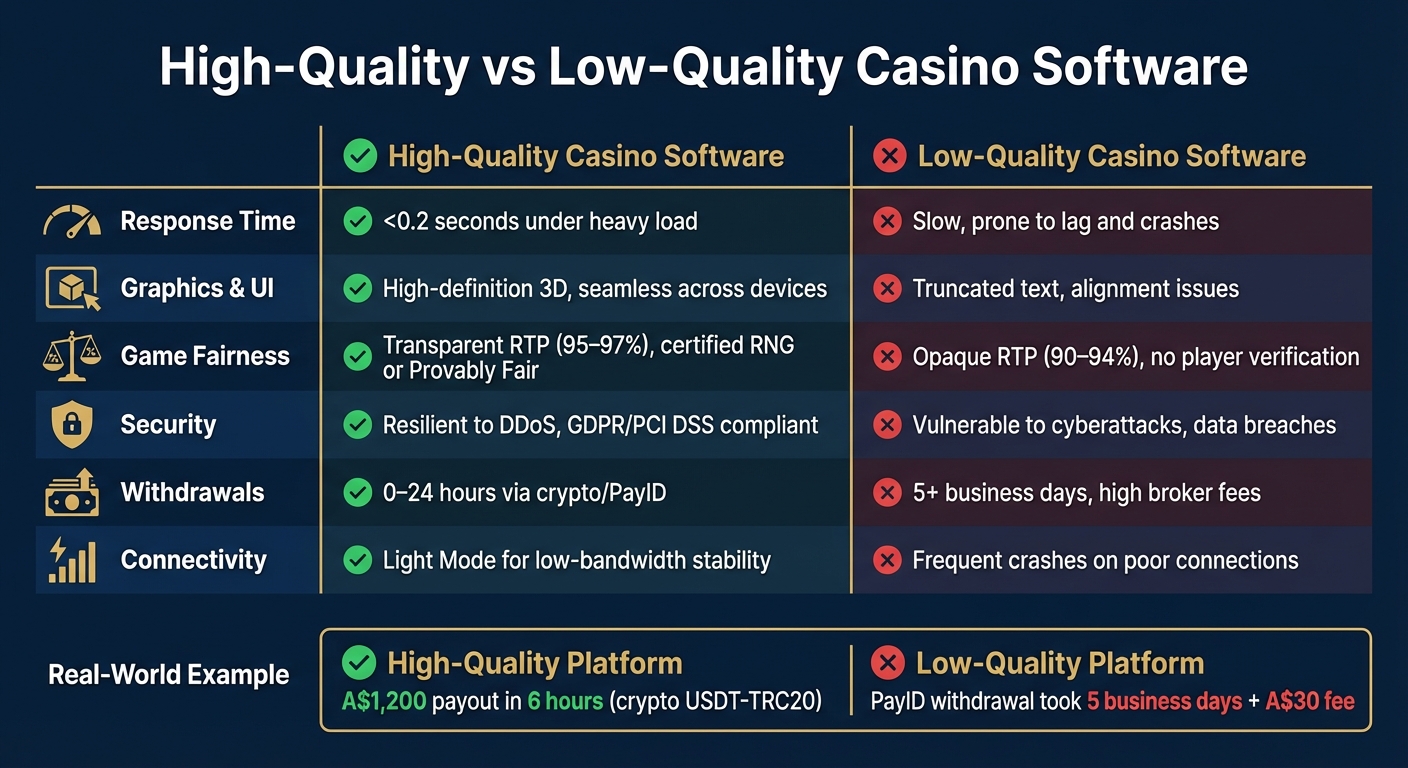
High-Quality vs Low-Quality Casino Software Comparison
The difference between low-quality and high-quality casino software can dramatically influence your gaming experience. From how quickly a game loads to how efficiently your winnings are processed, the software's quality determines whether you enjoy smooth gameplay or face frustrating setbacks.
Performance and graphics are clear indicators of software quality. High-quality platforms handle heavy traffic effortlessly, maintaining response times of less than 0.2 seconds, while lower-quality systems often lag or crash under similar conditions. Additionally, premium software delivers sharp, high-definition 3D visuals and ensures a seamless experience across devices. In contrast, poorly developed software struggles with issues like truncated text and poor mobile compatibility.
Fairness and transparency are where the contrasts become even more critical. Reliable software provides clear Return to Player (RTP) rates, typically between 95% and 97%, verified through Provably Fair algorithms. These allow players to independently confirm game outcomes using server seeds, client seeds, and hashes. On the other hand, low-quality software often features opaque RTP rates as low as 90–94%, draining your bankroll faster and offering no independent verification. As iGaming analyst Jack Robinson points out:
"Some providers are great for entertainment, others will significantly deplete your A$50 faster."
These differences extend beyond gameplay to impact security, withdrawal times, and connectivity, as outlined below.
Comparison Table
| Feature | High-Quality Software | Low-Quality Software |
|---|---|---|
| Response Time | <0.2 seconds under heavy load | Slow, prone to lag and crashes |
| Graphics & UI | High-definition 3D, seamless across devices | Truncated text, alignment issues |
| Game Fairness | Transparent RTP (95–97%), certified RNG or Provably Fair | Opaque RTP (90–94%), no player verification |
| Security | Resilient to DDoS, GDPR/PCI DSS compliant | Vulnerable to cyberattacks, data breaches |
| Withdrawals | 0–24 hours via crypto/PayID | 5+ business days, high broker fees |
| Connectivity | Light Mode for low-bandwidth stability | Frequent crashes on poor connections |
The financial implications of software quality are equally striking. In 2025, a player using a high-quality platform with crypto integration (USDT-TRC20) received a A$1,200 payout within six hours. In contrast, a PayID withdrawal on a less efficient system took five business days and came with a A$30 fee. Security is another area where lower-quality software falters. For instance, a major gambling technology provider experienced a cyberattack in November 2024, forcing their systems offline and damaging their reputation.
These examples highlight how software quality not only enhances gameplay but also creates a more secure and reliable gaming environment.
Conclusion
Casino software isn't just a behind-the-scenes component - it’s the backbone that ensures smooth gameplay, stunning visuals, verified fairness, and solid security. As AussieOnlineCasino.com aptly states:
"The software behind an online casino determines everything from game selection and graphics quality to banking speed and mobile performance."
As we've explored, top-tier software ensures fast response times, while weaker systems often struggle under pressure. Reliable platforms also defend against DDoS attacks and uphold GDPR compliance, minimising the risk of data breaches and downtime.
This isn't just theory - it’s reflected in how platforms perform. Take Aussie2Win, for example. By using software from providers like JILI and BNG, they offer Australian players a stable and secure gaming environment. Their commitment to fair play includes measures against fraud and collusion, while features like OTP verification and a "one account per player" policy enhance security. Add to that fast cashouts and a minimum withdrawal of A$50, and it’s clear they prioritise both player experience and safety.
Ultimately, the software provider you choose impacts everything - game variety, banking speed, security, and even the fairness of gameplay. For Australian players, selecting a platform with reliable software means enjoying a seamless, secure, and fair gaming experience, where every detail, from graphics to payouts, is optimised for quality and trust.
FAQs
How can I tell if a casino’s RNG is actually certified?
To verify if a casino's RNG (Random Number Generator) is reliable, look for certification from independent testing organisations like eCOGRA or approval from regulatory authorities such as the Malta Gaming Authority. These organisations ensure that RNGs adhere to strict standards, guaranteeing randomness and fairness in gameplay.
What makes games load faster on some casinos than others?
Games tend to load quicker on certain online casinos because of variations in their software infrastructure, server performance, and optimisation methods. These elements play a crucial role in how efficiently game data is processed and delivered, resulting in a smoother and faster gaming experience for players.
Which security features should I check before depositing money?
When choosing an online casino, make sure they use certified Random Number Generators (RNGs) to guarantee fair gameplay. Additionally, check for the use of encryption technologies to safeguard your financial data. Some platforms also employ advanced tools like blockchain or artificial intelligence for added security and transparency. These measures ensure both your personal information and gaming experience are well-protected.