Gamification is transforming iGaming, turning simple betting into engaging journeys. By using features like missions, leaderboards, and tiered rewards, platforms are keeping players engaged longer and boosting revenue. Here's what you need to know:
- Why it works: Gamification taps into psychology - autonomy, achievement, and social connection.
- Key benefits: Day-30 retention up by 22%, lifetime value up 40%, and player switching down 40%.
-
Effective strategies:
- Missions: Guide players with challenges that encourage exploration.
- Daily streaks: Build habits with escalating rewards.
- Tiered loyalty: Motivate with progress bars and exclusive perks.
- Social features: Use leaderboards and referrals to create community.
Platforms like Aussie2Win show how gamification drives loyalty and profit. For operators, the focus is shifting from bonuses to creating engaging, behavioural loops.
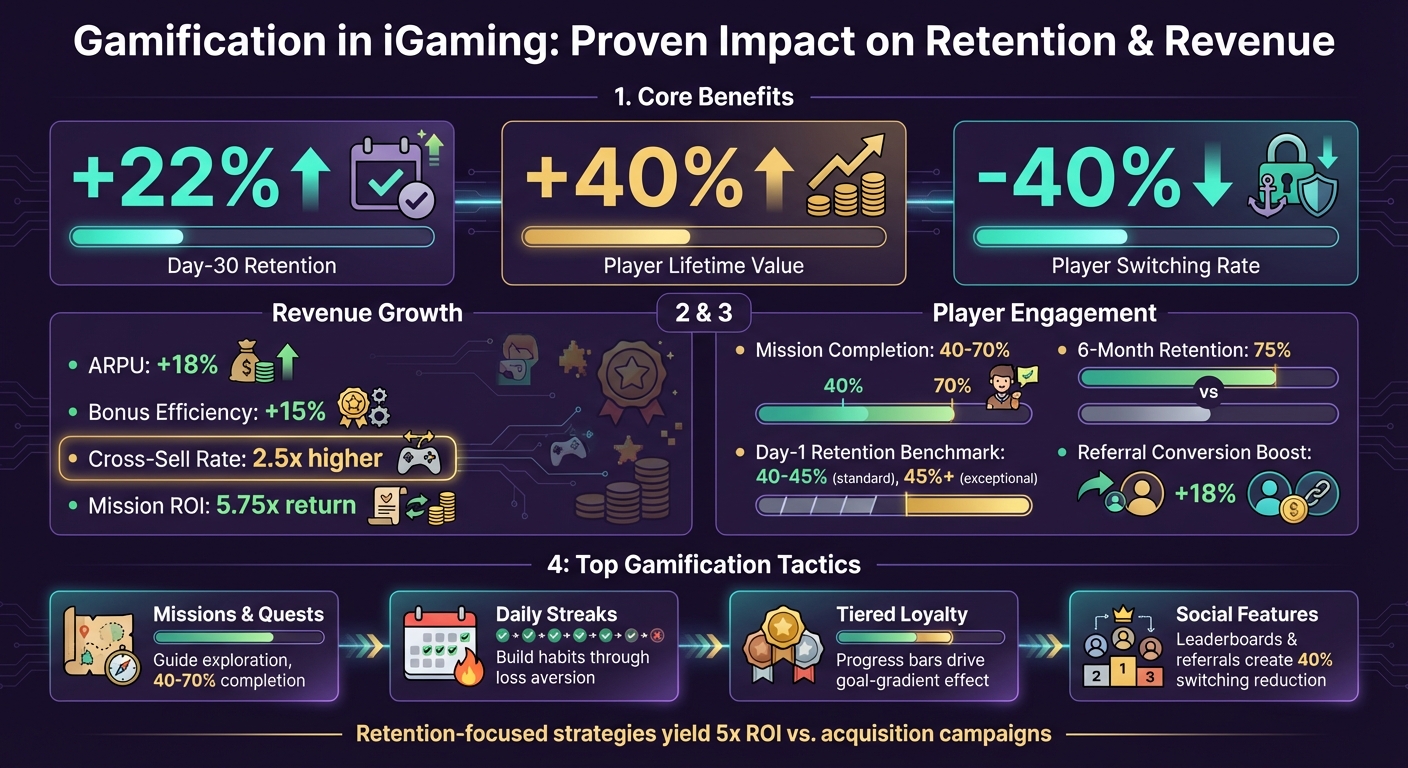
Gamification Impact on iGaming Retention and Revenue Metrics
Ep 658 Unlocking Player Loyalty: How Gamification Drives Smarter Retention
sbb-itb-b6f7e81
Gamification Tactics for Player Retention
Now that we understand why gamification works, let’s dive into the specific strategies that help keep players engaged. These tactics tap into the psychological drivers of autonomy, competence, and connection, transforming how players interact with iGaming platforms.
Missions and Quests
Missions and quests are a great way to guide new players through the platform while encouraging exploration. Instead of leaving users to figure things out on their own, structured challenges help them navigate key steps like account verification, making their first deposit, or discovering new features. This approach is especially effective during the first week, a crucial period for shaping long-term engagement. Research shows that well-designed missions can achieve completion rates of 40% to 70% and generate up to a 5.75x return on investment.
Take Aussie2Win as an example. Their "discovery mission" encourages sports bettors to try out three different casino games, rewarding them with bonus credits upon completion. By doing so, the platform introduces players to new features in a way that feels natural and rewarding, rather than forced.
Once players are familiar with the basics, daily challenges can take retention efforts to the next level by fostering consistent engagement.
Daily Challenges and Streak Rewards
Daily challenges are all about building habits. Features like daily check-ins and streak rewards encourage players to keep coming back, driven by both the excitement of earning rewards and the fear of losing progress. Loss aversion - essentially the reluctance to give up something already gained - can be a powerful motivator.
Aussie2Win uses daily check-in bonuses to great effect. Players who log in consecutively unlock escalating rewards, with a progress tracker showing how many days they’ve kept their streak alive. This visual feedback taps into players’ desire for achievement while also leveraging their reluctance to break a streak.
These daily interactions set the stage for even more impactful retention strategies, such as tiered loyalty programs.
Tiered Loyalty Programs
Tiered loyalty programs take player engagement to the next level by offering dynamic rewards that adapt to player behaviour. Unlike traditional VIP schemes that simply track spending, gamified tier systems actively encourage ongoing participation. For example, a static "1 point per $1 wagered" system merely logs activity, but a gamified approach - complete with progress bars and milestones - creates a sense of accomplishment and urgency.
Aussie2Win’s tier system, ranging from Bronze to Platinum, is a great example. Each level offers increasingly valuable perks, such as daily rebates, faster cashouts, and exclusive deposit lucky draws. Players can see exactly how close they are to reaching the next tier, which motivates them to keep playing. This taps into the "goal-gradient effect", where people work harder as they get closer to a goal.
Additionally, the best tier systems allow players some degree of choice, letting them customise their perks and reinforcing their sense of control.
| Business Goal | Tier Mechanic | Psychological Driver |
|---|---|---|
| Reduce VIP Churn | Real-time progress bars showing points to next level | Development & Accomplishment |
| Increase Wagering Frequency | Time-limited multipliers (e.g., "2X points this weekend") | Scarcity & Impatience |
| Drive Cross-Product Adoption | Tier-unlockable missions for new game types | Empowerment of Creativity |
| Build Platform Loyalty | Tier-specific leaderboards and exclusive access | Social Influence & Relatedness |
Competition and Social Features for Engagement
Competitive and social elements add a whole new layer of connection for players, going beyond individual progress. While tiered loyalty systems encourage personal commitment, features like leaderboards and social sharing create a sense of community that keeps players coming back. When players feel part of something larger - whether through friendly rivalries or shared achievements - they form emotional connections that go far beyond basic rewards.
Leaderboards and Achievement Badges
Leaderboards tap into the human instinct to compare ourselves to others. They offer instant feedback, pushing players to improve their ranking and tackle new challenges. This sparks intrinsic motivation. However, for leaderboards to be engaging, they need to feel fair. If global rankings are dominated by high-rollers, casual players might lose interest. To address this, many platforms segment leaderboards by tiers, stake levels, or betting volumes. This way, players compete against peers rather than being overshadowed by big spenders.
Achievement badges add another layer of motivation by acting as visual milestones of success. For example, a badge like "High Roller: Wagered A$50,000 Total" conveys prestige and expertise. To be effective, badges must be challenging to earn and prominently displayed. If they’re too easy to get, they lose their value. When done right, these features create what’s called a "social moat", reducing the likelihood of players switching platforms by 40%.
| Feature | Motivation Trigger | Best Practice |
|---|---|---|
| Leaderboards | Competition / Social Status | Use fair brackets and tier-based ranking |
| Badges | Mastery / Recognition | Make them challenging and publicly visible |
| Clans/Syndicates | Relatedness / Social Sunk Cost | Tie individual progress to group goals |
While leaderboards and badges celebrate personal achievements, referral programmes take it a step further by building social connections.
Referral Programs and Social Connections
Referral programmes do more than just bring in new players - they create shared experiences that strengthen social bonds. This taps into the Social Influence & Relatedness drive, a key motivator in gamification. When players invite friends, they turn what might be a solitary activity into a shared one.
A great example of this is Aussie2Win’s referral rewards programme, which has set a benchmark in 2026. This model benefits both the referrer and the new player, encouraging organic growth. Knowing that friends are also on the platform makes players more likely to stick around.
The best referral programmes don’t stop at one-time bonuses. Gamified referral banners that track progress and milestones have been shown to boost conversion rates by 18%. Paired with features like chat options, achievement sharing, and multiplayer tournaments, these social tools foster a strong sense of belonging. Platforms that integrate these features report retention rates of up to 75% over six months, compared to about 50% for platforms without gamification.
Measuring Gamification Success
Tracking the success of gamification is essential to justify its investment. Operators must focus on metrics that demonstrate whether these strategies genuinely engage players and drive revenue. By measuring the right data, businesses can connect gamification efforts to long-term player retention and profitability. The emphasis should be on meaningful KPIs rather than surface-level stats like signups or page clicks. The ultimate goal? Ensuring gamification leads to longer player engagement and increased revenue.
Retention Metrics and KPIs
Key performance indicators (KPIs) for gamification fall into three main areas: retention, engagement, and financial performance. To assess retention, monitor Day 1, Day 7, and Day 30 retention rates to see how many players return after signing up. A Day-1 retention rate between 40–45% is considered standard, with anything above 45% being exceptional.
Engagement metrics include Daily Active Users (DAU), Monthly Active Users (MAU), session duration, and participation in gamified activities like quests or missions. These metrics directly influence financial outcomes.
On the financial side, metrics like Average Revenue Per User (ARPU), Average Revenue Per Paying User (ARPPU), and Gross Gaming Revenue (GGR) uplift reveal whether gamification is driving spending and profitability. Long-term indicators, such as Player Lifetime Value (LTV) and Churn Rate, provide insights into sustained profitability. As Denis Kosinsky, Chief Operating Officer at NuxGame, explains:
The future of KPI use in iGaming is about focusing on the right numbers at the right time. Small changes in player behaviour can signal significant trends.
One effective way to measure gamification's return on investment (ROI) is through cohort analysis. This method compares metrics like GGR uplift, retention rates, and churn between gamified users and a non-gamified control group over periods of 30, 60, and 90 days. Retention-focused strategies like this can yield up to five times the ROI compared to campaigns centred on player acquisition.
With these KPIs established, the next step is comparing the performance of gamified platforms against their non-gamified counterparts.
Gamified vs. Non-Gamified Platforms
Platforms that integrate advanced gamification strategies often see significant improvements across key metrics. For instance, Day-30 retention can rise by 22%, reducing the need for costly re-acquisition efforts. ARPU may increase by 18%, fuelled by cross-vertical quests that encourage players to explore different game types. Even more impressively, LTV can grow by 40%, extending the profitable engagement period of each player.
| Metric | Impact | Why It Matters |
|---|---|---|
| Day-30 Retention | +22% | Cuts down on expensive re-acquisition campaigns |
| ARPU | +18% | Boosted by cross-vertical quests (e.g., sports to casino) |
| LTV | +40% | Lengthens the profitable lifespan of players |
| Bonus Efficiency | +15% | AI ensures rewards are targeted, not broadly distributed |
| Cross-Sell Rate | 2.5x higher | Increases revenue diversity across the platform |
Operators who combine loyalty programmes with gamification report retention rates up to 40% higher compared to those relying solely on bonuses. A major factor behind this success is the use of instant data feedback. As Raul A., a G2 Reviewer, points out:
Real-time data makes it easy to optimise campaigns quickly.
Additionally, rewards must be delivered within seconds of player actions, especially during emotionally charged moments. This immediate feedback helps sustain the psychological loop that makes gamification so effective.
Conclusion
Shifting from transactional to behavioural engagement is reshaping how iGaming platforms approach player retention. Will Hansen from Xtremepush captures this transformation perfectly:
Real gamification changes behavior. When operators need to increase player engagement and reduce manual campaign work, they don't just add more points tiers. They design behavioural loops with missions, streaks, and real-time tier updates that make progression visible and completion satisfying.
This shift moves operators away from the outdated "burn and churn" strategy and towards a more sustainable model that keeps players engaged over the long term.
The metrics back this up. As previously discussed, combining extrinsic rewards like bonuses with intrinsic motivators such as status, mastery, and social connection has proven to be a winning formula.
Platforms like Aussie2Win exemplify this approach. They integrate features like daily check-ins, tiered loyalty programs, and referral rewards. With offerings such as daily 8% rebates and deposit-based lucky draws, they create immediate feedback loops that engage players at emotionally charged moments. These features, combined with social elements, foster a sense of commitment - making players 40% less likely to leave for another platform.
The days of relying solely on deposit bonuses are behind us. As SourceCodeLab aptly puts it:
The path to profitability is no longer paved with aggressive bonus-matching; it is built on sustainable engagement architecture. The era of 'burn and churn' marketing is over. For operators looking toward 2027 and beyond, deep, psychologically-sound gamification is no longer an 'add-on' - it is the core product.
FAQs
Which gamification tactic lifts retention fastest?
The quickest way to improve retention in 2026 is by leveraging AI-driven personalised narrative journeys. This approach taps into behavioural engineering to craft interactive, tailored experiences that resonate with each individual player. By aligning content with user preferences and behaviours, it helps minimise churn and keeps players actively engaged.
How do you design fair leaderboards for casual players?
To make leaderboards fair for casual players, it's important to emphasise balance and inclusivity. One way to achieve this is by using tiered or segmented leaderboards, which group players based on their skill level or activity. This ensures that new or casual players aren't competing directly with highly experienced ones.
Additionally, offering achievable rewards that recognise effort rather than relying on luck or large bets can make participation more rewarding. This method encourages fairness, boosts motivation, and keeps casual players engaged without creating a sense of overwhelm.
What KPIs prove gamification ROI in iGaming?
When it comes to evaluating the success of gamification in iGaming, a few key performance indicators (KPIs) stand out. These include:
- Player retention rates: This measures how well your gamification efforts keep players coming back over time.
- Lifetime value (LTV): A critical metric that shows the total revenue a player generates throughout their time with your platform.
- Engagement metrics: These track player interaction with gamified elements, such as challenges, leaderboards, or rewards systems.
- Return on investment (ROI): This reflects the financial gains achieved through gamification, particularly from increased player activity and loyalty.
By focusing on these KPIs, you can better understand how gamification impacts player behaviour and contributes to overall business growth.